Delivering Innovative Solutions for Asset Management, Maintenance & Training
Energy and utility firms must contend with an increasingly diversified, decentralising, and digitising sector. Hiring managers in the utilities industry confront significant difficulties in finding qualified employees, with a lack of technical skills, training, and experience among the key obstacles. The use of virtual reality and augmented reality in the utility industry can help firms increase their efficiency by better educating staff to respond to unexpected circumstances faster, boosting situational awareness and employee proactivity rather than reactivity, and providing better working conditions.

Upskill and reskill your workforce effectively without subjecting them to dangerous environments. Enable Remote Assistance at any time.
Maximize asset performance, improve workforce productivity and minimize operational costs.
Explore new and innovative ways of working and engage stakeholders in all stages of a project and operations.
Use Digital Twins to deepen customer engagement for more meaningful interactions and new revenues.
“Market forecasts show Energy and Utilities ranking among the top three verticals in terms of
Augmented Reality (AR) glasses shipments and total value chain revenues which is estimated to grow to
US$18bn by 2022.”
(Source: ABI Research)
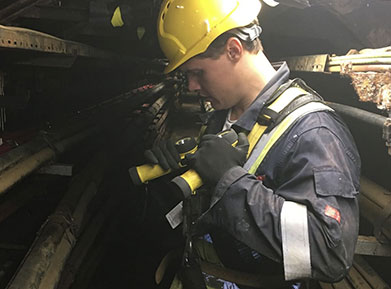
Training and on-boarding of new technicians and engineers can be a costly and time consuming task for utility organisations. Augmented Reality technology can be used to reduce this significantly by facilitating accelerated learning and making asset specific information available at the point of need. Digital Twins help technicians get a better understanding of equipment than they can achieve with 2D drawings and can be used to view the internal components of a piece of equipment and explore its inner workings in a safe environment. Simulating real life situations enables technicians to be taught site safety practices without exposing them to dangerous environments, ensuring they are adequately trained to combat situations they may encounter in the workplace.
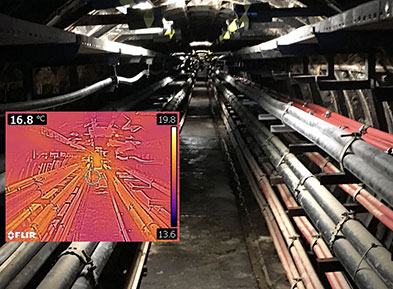
PAULEY ran a pilot project with CAPITA looking into how augmented reality overlays could be used to assist with workforce safety on site. Using thermal cameras, PAULEY created a series of visual overlays onto a tunnel pipe network that highlighted hazardous areas of extreme temperature to be avoided. This project was the first of a series of trials into the potential use of immersive technologies to improve working environments and health and safety in hazardous conditions.
“Market forecasts show Energy and Utilities ranking among the top three verticals in terms of Augmented Reality (AR) glasses shipments and total value chain revenues which is estimated to grow to US$18bn by 2022.”
(Source: ABI Research)
Remote Assistance
Many organisations waste time and money getting the correct personnel to the right place in order to complete tasks. Digital Engineer (Remote Assist) functionality allows a remote expert to guide local technicians on the ground through processes and provide them with immediate feedback, enabling them to take the actions required to fix the problem.
Predictive Maintenance
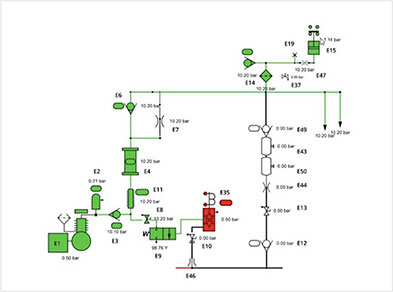
The PAULEY Dynamic Schematic platform integrates fault reports with network diagrams and the location of assets and components. The Fault mode represents the actions taken on the actual equipment and shows elements working or that have failed, a guided process to the resolution, and if not, then a connection to the systems and teams that the fault can affect so business decisions are recorded and actionable.


Contact Us today to discuss a potential project, arrange a demonstration or ask any questions.

At our heart, PAULEY are Spatial Computing Pioneers. An award-winning UK-based team of Digital Innovation Specialists.
Be the first to hear about our news, insights and resources. Sign up to receive our newsletter
| Cookie | Duration | Description |
|---|---|---|
| cookielawinfo-checkbox-analytics | 11 months | This cookie is set by GDPR Cookie Consent plugin. The cookie is used to store the user consent for the cookies in the category "Analytics". |
| cookielawinfo-checkbox-functional | 11 months | The cookie is set by GDPR cookie consent to record the user consent for the cookies in the category "Functional". |
| cookielawinfo-checkbox-necessary | 11 months | This cookie is set by GDPR Cookie Consent plugin. The cookies is used to store the user consent for the cookies in the category "Necessary". |
| cookielawinfo-checkbox-others | 11 months | This cookie is set by GDPR Cookie Consent plugin. The cookie is used to store the user consent for the cookies in the category "Other. |
| cookielawinfo-checkbox-performance | 11 months | This cookie is set by GDPR Cookie Consent plugin. The cookie is used to store the user consent for the cookies in the category "Performance". |
| viewed_cookie_policy | 11 months | The cookie is set by the GDPR Cookie Consent plugin and is used to store whether or not user has consented to the use of cookies. It does not store any personal data. |



