

3D Spatial Operations Room Toolkit
The Challenge
Every modern organisation of significant size, regardless of the field of activity in which it operates, needs state-of-the-art control and security systems. The environments in which these systems are accessed are called Control Rooms. These are critical for overseeing and actively managing complex systems of all kinds. Conventional control rooms rely heavily on network data alerts and information displayed across numerous flat panel 2D monitors and diverse software system interfaces.
The primary function of a Control Room is the systematic monitoring of an organization’s technological infrastructure, intertwined with the timely analysis of field data. The overarching aim is to ensure the continuous operation of installations, streamlining and expediting operators’ decision-making processes.
However, over time, whilst the core function of control rooms have remained consistent, operational ecosystems have evolved significantly.
Firstly, perceptions of criticality have expanded beyond internal concerns to encompass external factors. Attention is directed not only to events within the organisational footprint but also to potential external sources of information including broadcast and social media.
Secondly exponential growth in both the quantity and diversity of intercepted data is generating a need for better tools for the efficient organisation, interpretation, and utilisation of data. Organisations are seeking ‘awareness capability’ – the capacity to orchestrate data and sources effectively, to enhance the aggregation, correlation, and presentation of information essential for decision-making and incident resolution.
Thirdly the geographical range and scope of systems and resources available for monitoring and adjustment from Control Rooms has expanded significantly, thanks to modern real-time telecommunications and the Internet of Things (IoT).
Finally, events monitored from Control Rooms tend to play out at an increasingly rapid pace because other actors (hostile and friendly) are also capable of detecting events and making counter-moves. This creates a real risk that actions taken by those actors will ‘get inside the cadence’ of decision-making, preventing staff from getting the situation back under control.
Due to a traditional reliance on 2D flat panel monitors, operators are usually required to interpret information about real events playing out rapidly in three dimensions by interpreting data displayed in two dimensions. This is arguably creating additional unnecessary cognitive load.
These changes are conspiring to create real challenges for control room staff, who are being presented with more and more sources of data to factor into their decision-making and given less and less time to orientate themselves, interpret the data and then act on it.

Our Solution
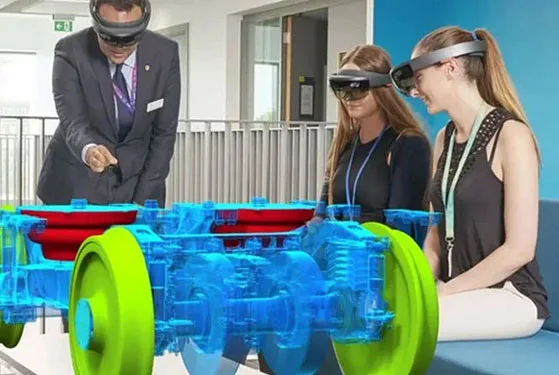
Our Spatial Control Room Toolkits expand the ‘field of view’ of control room Operators to create a three-dimensional spatial picture of events within the organisation’s footprint and potential sources of valuable information including broadcast and social media from the wider world, all integrated into a singular, immersive HoloLens 2 holographic experience. The ‘gods-eye view’ delivers awareness capability by centralising data monitoring and thereby generating insights, allowing operators to oversee complex geographically dispersed networks, assets or processes, observe issues and orient themselves quickly and easily, without the clutter of multiple monitors and disparate systems.
Better still thanks to the communications links embedded into every HoloLens 2, Operators can liaise directly with colleagues in the field, in their own control room and in others linked to it. Wearing HoloLens does not inhibit the use of traditional systems or control interfaces or prevent face-to-face discussion with colleagues.
Operators can even take their own ‘control room’ with them ‘on the road’ and both view and interact with the usual virtual facilities from the location of their choice, enhancing resilience and flexibility in emergency situations.
Operators have the benefit of interpreting information about real events playing out rapidly in three dimensions by interpreting data displayed in three dimensions, as spatial holographic maps, plans and custom infographics. This reduces their cognitive load and level of stress.
Having formed an accurate appreciation of situations and then reached informed decisions, Operators are able to use gesture control or alternative connected hardware such as an X-Box controller to make suitable remote adjustments.


Who is this for?
- Anyone charged with monitoring and controlling system performance, managing Control Rooms and teams of Operators to optimise utilisation, workflow and safety
What can I use this for?
- Business continuity planning
- Disaster recovery planning
- Electrical systems monitoring and control
- Mechanical systems monitoring and control
- Mechatronics systems monitoring and control
- Civil Engineering systems monitoring and control
- Chemical Engineering systems monitoring and control
- Aeronautical Engineering systems monitoring and control
- Petroleum Engineering systems monitoring and control
- Computer Engineering systems monitoring and control
- Systems Engineering systems monitoring and control
- Industrial Engineering systems monitoring and control
- Nuclear Engineering systems monitoring and control
- Rail Engineering systems monitoring and control
We would love to hear from you
Complete the form below and someone will be in touch to discuss your 3D Spatial Operations Room requirements.
Each of our six solutions resolves key challenges faced by sales, marketing, corporate communication, training, education, engineering and senior leadership teams operating in critical infrastructure, defence, security, and emergency services.
Each product acts as a tried-and-tested building block for incremental digital transformation.




Don’t forget to follow us on LinkedIn!


